Product · Systems · Decision-Support

Who am I

Most operational problems are systems problems disguised as software problems.

I am a senior product leader specialising in transport management systems, optimisation and complex operational software. Over 20 years' experience helping organisations understand, improve and scale systems that manage millions of transactions per day.

20+ Years Experience Enterprise Transport Management Systems MBA | MSc Computer Science | FCILT

Open Interactive Portfolio Magazine

Why this matters

Most organisations do not understand the system they operate in. They rely on intuition, dashboards, inherited assumptions, and linear planning in environments that are anything but linear. Product decisions are then made around visible symptoms rather than the deeper structures driving behaviour. The result is predictable: misaligned incentives, hidden constraints, unintended consequences, and features that solve local problems while creating wider system friction.

My work exists to fix this. I bring structure to ambiguous product problems, reveal the real drivers of system behaviour, and help teams design products, models, and decision-support tools that support clearer thinking and improved decision making.

Every system is perfectly designed to get the results it gets
Deming

What I do

I help organisations turn complex operating environments into better product decisions.

That means helping teams: understand the system — identify the constraints, dependencies, behaviours, incentives, and risk points shaping real-world outcomes.

Model dynamic behaviour — use simulations, scenarios, decision models, and prototypes to test assumptions before committing to a product direction.

Design for confident action — create software and workflows that support judgement, prioritisation, planning, and operational control.

It is not "data-driven" product management in the shallow sense of reporting what has already happened.

It is structural clarity: understanding how the system works so product teams can decide what to build, what not to build, where to intervene, and how to design software that supports confident action.

You cannot optimise a system by optimising its parts
Ackoff

How I think or why I think like I do

My product approach is shaped by an unusual combination of History, Computer Science, Business, and Logistics.

History gave me evidence-led thinking and a long view of how systems change. Computer Science gave me technical structure, modelling, and software reasoning. Business added strategy, operating models, and commercial value. Logistics grounded all of it in real-world operational pressure.

That mix is central to how I work as a product manager: connecting operational reality, technical possibility, commercial priorities, and the wider system around the product.

It is a capital mistake to theorise before one has data
Sherlock Holmes Conan Doyle

How I Work: The Clarity Cycle

A practical three-stage approach for making sense of complexity, reducing ambiguity, and turning messy operational problems into software that supports decisions that account for complexity.

Understand the System

Before designing a solution, I work to understand how the system actually behaves. That means mapping the domain, surfacing constraints, identifying dependencies, and capturing the mental models of the people who operate inside the system every day.

The aim is to move beyond assumptions and build a shared understanding of the system’s structure, behaviours, trade-offs, and failure points.

Model the Complexity

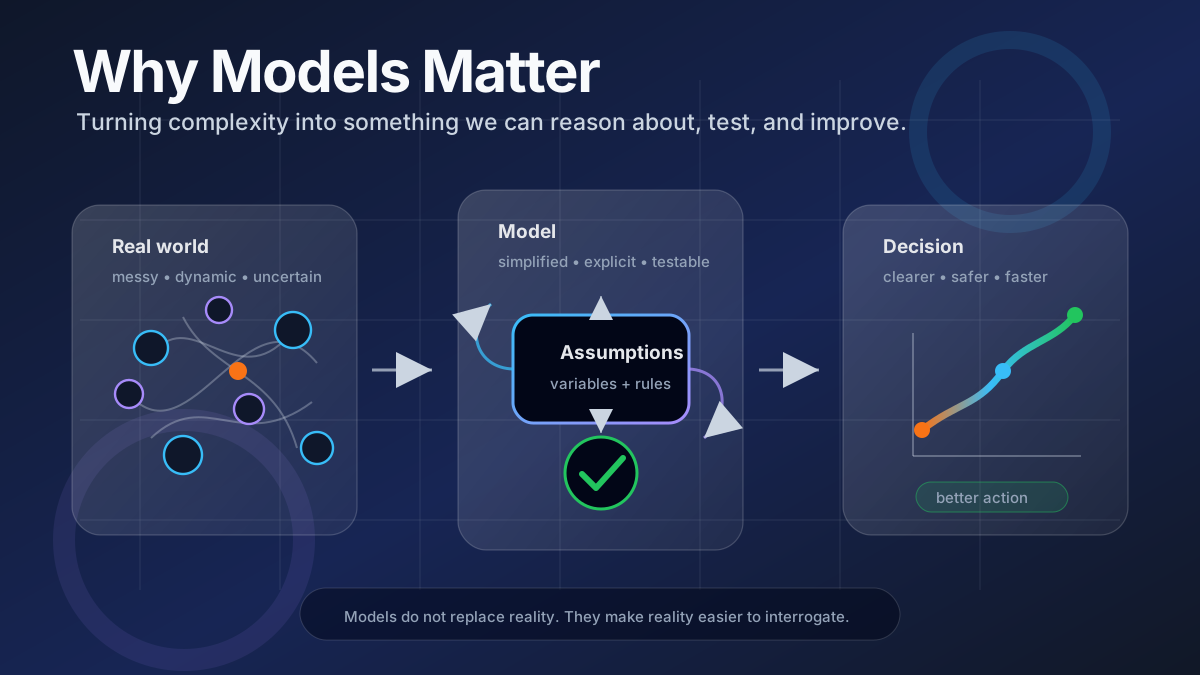
Once the system is understood, I turn complexity into something visible and testable. That might mean a conceptual model, process model, simulation, decision model, data model, or prototype.

Good models do not remove complexity. They make it easier to reason about. They help teams explore scenarios, compare options, expose uncertainty, and understand the likely consequences of different decisions.

Design for Decision-Making

The final stage is designing software that helps people think and act with greater confidence. The goal is not just to digitise an existing process, but to create tools that support judgement, prioritisation, planning, and operational control.

For complex domains, good software should not hide reality. It should make the right information visible at the right time, so experts can take appropriate action under pressure.

Causal diagram showing how system structure drives behaviour
Structure drives behaviour: mapping the causal loops that produce system outcomes.

Featured Projects

Work Simulator

Featured

A Monte Carlo simulation platform for testing complex project outcomes under uncertainty. It models variable inputs, probability ranges, risk factors, dependencies, and constraint scenarios to show likely outcomes, confidence ranges, and failure points before decisions are committed.

JavaSpring BootPostgreSQLAI/ML
Read Case Study

Garmin Analysis Platform

Featured

A personal performance analytics platform that combines Garmin activity, sleep, recovery, heart-rate, endurance, and training data to identify trends that are difficult to see in the raw metrics. It is designed to turn fragmented wearable data into practical insight on fatigue, recovery, fitness progression, and training effectiveness.

PythonJavaSpring Boot
Read Case Study

Resource Generator

Featured

A transport masterfile and resource creation tool designed to remove the manual effort involved in preparing realistic demonstration, testing, and onboarding data. It generates structured driver, tractor, depot, shift, contract, GPS, payroll, and reference data from configurable inputs, helping create more credible software scenarios quickly and consistently.

PythonDjangoPandas
Read Case Study

NHS IT Risk Tool

Featured

A structured risk analysis platform for assessing software delivery, operational change, data quality, implementation readiness, and system behaviour. It combines scoring, evidence capture, risk drivers, warning indicators, and mitigation logic to make risk assessment more repeatable, explainable, and useful for decision-making

PythonDjangoPandas
Read Case Study
View All Projects

Research & Dissertations

Service Quality and Student Loyalty

Research into how perceived service quality influences student loyalty, satisfaction, and retention in higher education. The project uses the SERVQUAL model, which assesses service quality across five dimensions: reliability, assurance, tangibles, empathy,and responsiveness. It explores how gaps between student expectations and actual experience can affect trust, engagement, recommendation behaviour, and the likelihood of students continuing with an institution

Read Dissertation

Genetic Algorithms for Design of Experiments

Research into the use of genetic algorithms to solve the Travelling Salesman Problem, a classic optimisation problem focused on finding the shortest possible route through a set of locations. The project used Design of Experiments methods to tune the genetic algorithm’s parameters, testing how factors such as population size, mutation rate, crossover strategy, and selection method affected solution quality, convergence speed, and algorithm stability

Read Dissertation

Featured Writing

Systems Thinking in Product Management

Systems Thinking in Product Management

Featured

1 June 2026

How systems thinking reframes product decisions, surfaces hidden constraints, and improves long-term outcomes.

Product Thinking
Read Article
Probabilistic Forecasting for Product Management

Probabilistic Forecasting for Product Management

Featured

15 June 2026

Using probabilistic models to make better forecasts, surface uncertainty, and inform risk-aware decisions.

Modelling
Read Article
Schumpeter and Creative Destruction

Schumpeter and Creative Destruction

Featured

12 March 2026

Reflections on innovation, disruption, and how organisations can respond to structural change.

Writing
Read Article
Braudel: Longue Duree and Systems

Braudel: Longue Duree and Systems

Featured

20 April 2026

Applying Braudel's longue duree perspective to product strategy and systemic change.

History
Read Article
View All Writing

Need clarity in a complex operational system?

Explore my approach to product thinking, modelling, and decision-support

Let's untangle your system